
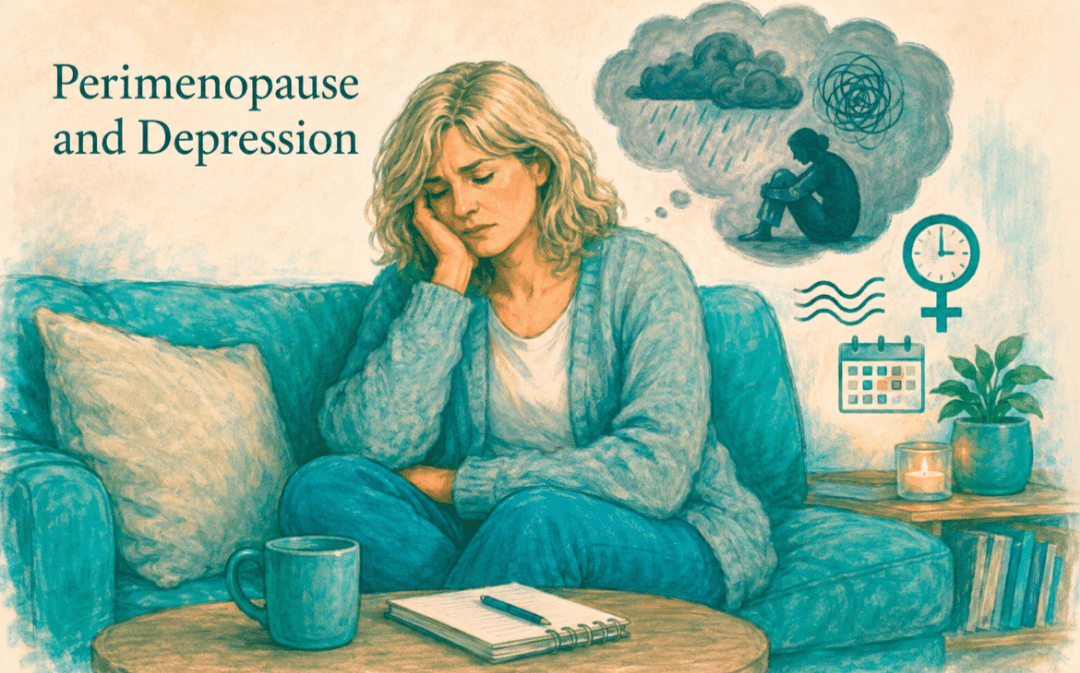
In this blog I will be talking all about perimenopause and depression and giving resources and strategies to help you. We will look at why women can feel low during this natural transition and my aim is to give hope that you can find ways to lift mood and be able to continue your life with hope and a more positive outlook. Perimenopause can be tough but it doesn’t last forever and many people find that, once this phase has passed, your body and mind starts to settle.
What is Perimenopause?
The first sign of perimenopause is normally when you notice that your periods become more irregular. Eventually they will stop altogether and then you will be in menopause. Menopause is that final period after twelve months. From then you are in ‘post’ menopause and this continues for the rest of your life.
What are the symptoms of Perimenopause?
There are many symptoms of perimenopause. Some stats say over thirty and they vary from person to person. Generally, these are some of the main symptoms, both physical and emotional:
Physical
Hot flushes and night sweats
Irregular periods
Loss of libido (sex drive)
Vaginal dryness (itching, discomfort)
Fatigue, tiredness or exhaustion
Dizziness
Sleep disturbances
Weight gain
Headaches or migraines
Bloating
Hair loss, thinning
Dry itchy skin
Brittle nails
Racing heart
Gut issues
Urinary issues (UTIs)
Allergic reactions
Emotional and mental health issues
Low mood
Depression, from mild to severe
Low self-esteem
Lack of confidence
Brain fog
Memory issues
Meltdowns/shutdowns
Dissociation/zoning out
Inability to focus
Agitation
Loss of control
Unable to do tasks
Stress and chronic stress
Anxiety
Anxiety or panic attacks
Loss of identity
Self-harm and suicidal ideation
Unhealthy coping mechanisms – addiction
Hopelessness/helplessness
Crying
Frustration, irritability, anger
Exisiting mental health issues like trauma or negative life event triggers worsening
Feeling numb, joyless
Loss of meaning and purpose
These two lists are to show what might be happening for you. Any one of them can vary in intensity and you may find you have some and not others. There are strategies that can be used to help for all of them and there is support available. It might come in the form of:
Speaking to your GP
Joining a menopause group locally (Google this)
Getting support from a dedicated menopause specialist
Exploring Hormone Replacement Therapy (HRT)
Looking at holistic alternatives such as meditation, yoga, somatic practises, nature therapy
Coaching
Counselling
Psychotherapy
Hypnotherapy and guided imagery
Searching for podcasts, webinars, books, audiobooks, articles, radio and TV resources
Depression and perimenopause
This blog focuses on depression during perimenopause. I will be doing other posts about different mental health challenges during menopause, such as anxiety, stress, addiction and trauma.
Getting essential emotional needs met
As a Human Givens Practitioner, I work with my clients to see what emotional needs are not being met and together, we find ways to improve this. Let’s look at which emotional needs are often a challenge during perimenopause.
Security
You might feel insecure about your body and mind. There will likely be many changes happening and this, in itself, can make you feel insecure.
Financial insecurity is often a big marker for stress, anxiety and depression. Many women are unable to work when perimenopause symptoms are severe and this can affect your work life and ability to earn money. It is a legal requirement for organisations to support you and it is your right to ask for support. Here is a link to information about your rights.
Your relationships can be affected by perimenopause – friendships, family, partners or work colleagues. This can lead to insecurity. Counselling can help you find ways to communicate your needs more effectively. But it is not just your responsibility. This is where couples therapy can benefit. Speaking openly to family and work colleagues can help. Women make up half of the population. Your needs are important.
Control
During perimenopause you might feel as though you are not in control. Perhaps you feel as though no one is listening and you feel unheard or unseen (invisible). There are things going on in your mind and body that, on your own, you cannot control, especially where your hormones are concerned. When you feel a lack of control over time depression can set in. Depression doesn’t just arrive overnight. It happens gradually when you are not getting your needs met.
Because of the many symptoms you might be experiencing it can become confusing and scary around what you can and can’t control. This is where a therapist can help. There will be things you can control and we can look at these. This is important as it gives you power. Sometimes you may need to accept that there are things you cannot control and leave them be, for now.
Privacy
Privacy can mean too much or too little. Let’s explore this.
Too much privacy can mean feeling lonely. This can happen in your self – not feeling heard, seen or validated. It can mean a loss of identity and the feeling that you are on your own. It can also mean that you are actually on your own, without a support system close by. Perhaps you live on your own or don’t have family or friends near to hand. It will be no surprise that this can make you feel depressed.
We will talk about how to connect and overcome this loneliness further on in the blog.
Not enough privacy. This can lead to high stress arousal and anxiety, which, in turn, can lead to low mood and depression. Here is how the NHS defines depression:
https://www.nhs.uk/mental-health/conditions/depression-in-adults/overview/
Like a wounded animal that disappears off into the woods to heal, humans need this too and during perimenopause this is very much the same. You need a place to heal.
There can be different reasons why you are not able to get privacy – in the home or at work for instance – but you need alone time. Without it you may feel angry or highly anxious and tearful. This can be particularly fraught when you are a mum and have a busy household.
How can you find time for yourself today? I understand how hard it can be to ask for support. You may have been used to doing everything yourself, but now you are experiencing perimenopause, everything has changed. You need help and to be able to get your needs met.
Any small amounts of time alone will benefit. Here are a few suggestions:
Getting up an hour earlier, before the house wakes up and becomes busy. Just being able to sit quietly with a hot drink to see how you are feeling and allow yourself to prepare for the day. Some gentle yoga or controlled slow breathing works well. You Tube has a lot of gentle exercises you can try or you could listen to something on your headphones.
If you are experiencing any type of pain, perhaps you can take some over the counter pain relief medication now, to give it time to work. You may choose to have a relaxing bath or shower at this time, with no other people competing for your attention. If you have a dog, a walk outside to get some beneficial vitamin D and fresh air will help. If you have a cat, sitting and stroking a purring furry friend is comforting.
It can be tricky getting time for yourself during the working day but it is very important to take regular rest breaks, even for ten minutes. Hide in the loo or even sit in your car and take some slow breaths. For every one and a half hours at work employees should have a ten-minute break. Few do. For you, going through perimenopause, it is very important.
You deserve to have private time and you absolutely need it. It might be time to set a few boundaries here. A counsellor or coach can support you with setting boundaries.
Connection
Do you have any friends who are also going through menopause? It can be so nurturing to spend time with another women who gets what you are going through. It can raise a few laughs too – especially around hot flushes and sex issues!
In many GP surgeries they have started menopause groups. This is a great way to feel connection and possibly even make new friends along the way.
If you have a mother, sister, cousin or aunty, can you get in touch, by phone or in person? Your female family members may have some great advice and just be there to offer reassurance.
‘Connection’ means different things to different people. You might find connection in your favourite films or TV programmes. It could be your pet or even playing games on your phone. Facebook, Instagram, Tik Tok or Linked In – all give ways to connect and focusing on who is interested in perimenopause and mental health can support you immensely. There are a number of really good FB groups around menopause.
Meaning and purpose
During perimenopause it can feel like you are fire-fighting all the time. If it’s not one symptom you’re dealing with, it’s another. You can find yourself losing what is important to you and what gives you a reason to get out of bed in the morning.
During perimenopause you might be raising children. You could have a daughter who is going through their own hormonal changes while you are going through yours. This can be a tough time, but look at it another way. This is an opportunity for bonding and understanding. There is real meaning to be had here.
Many women going through perimenopause might be caring for elderly parents. One day they will no longer be around. Having a sense of purpose by giving this help is one of the most compassionate and loving things a woman can do. Helping others has huge benefits for mental health and lifting depression.
If you are finding that you are not enjoying the things that you used to during perimenopause, it can feel as though there is no meaning to your life. Perimenopause is one stage of your life. This stage will move on at some point. Maybe think of other, less taxing activities you can do to give yourself meaning which don’t take your energy or cause stress.
Attention
Do you find that you are giving attention to everyone else but are not getting the attention you need? Perimenopause is a time when you really need to prioritise your needs and pay attention to yourself. Now, more than ever, you need to rest and spend time on self-care, without guilt or shame.
Perimenopause makes women feel vulnerable. There is power in vulnerability. If you haven’t seen this, Brene brown has this wonderful Ted Talk called ‘The Power of Vulnerability. Here’s the link.
https://youtu.be/iCvmsMzlF7o?si=B5ZkeFxeuOPAYKnM
Finally…
Depression can be periods of time of low mood to intense feelings of not wanting to carry on. You are not alone. Many women feel depressed during perimenopause, please remember, there is support out there.
I am 61 and have gone through perimenopause. I still have symptoms relating to the change in hormones now. Once oestrogen and progesterone packed their bags there have been all sorts of things I need to care about, every day. I need to look after my joints and bones. Having a nutritional diet is vital to ensure I get key vitamins, such as B12, D, iron, magnesium, omega 3 and more. My moods fluctuate and I can feel down sometimes.
For me, it has been about educating myself. I have learned so much about how to feel better and I would love to share more about what I have learned to support you.
You are welcome to take a look around my website at www.freshstart.me.uk and if you would like a free, twenty-minute phone or zoom chat to explore counselling then do send me an email at sallyanne.nilsson@yahoo.com I offer online counselling and coaching nationally in the UK and face to face therapy at my private practice in Frome, Somerset. Sessions are for one hour and cost £70. Couples therapy is £100.
Depression during perimenopause is common. You don’t have to suffer alone. There is a light at the end of the tunnel and we can all get to that light by asking for help when we need it. For now, I hope some of this information has been of help and I will be writing more blogs on how to feel better during the menopause years in the coming weeks and months.